
District 3 commission candidates give views, goals
The Franklin County Citizen Leader submitted a list of questions for candidates qualified to run in the May 19 primary. The answers to those questions were used to write a profile of the candidate. The questions were:
1. What experience (professional, personal or service) do you feel best qualifies you and will serve you best in the position you seek?
2. What is the biggest challenge facing Franklin County? How will you deal with that challenge?
3. Give one short-term goal and three longer-term goals that you would like to see the county accomplish by the end of your term.
4. What should the county’s policy on residential, commercial and industrial development be?
5. How do you think the county should solve its water supply issues?
6. If you had a chance to speak one-on-one with each registered voter in the county, what would you say to secure his or her vote?
Candidates were also asked to provide information about background, education, past service in government or with community organizations, church and family.
Elizabeth Busby
By Shane Scoggins
Publisher
CARNESVILLE – Elizabeth Busby is proud of what she has accomplished in her first term as the District 3 representative on the Franklin County Board of Commissioners.
“But I also know there is still important work ahead,” she said she would tell voters. “Over the past three years, I have gained valuable knowledge about how county government works, built strong relationships, and developed a deeper understanding of the needs of our community. I remain committed to being transparent, accessible and responsive to the people I serve.”
Busby is seeking reelection to the seat.
A lifelong resident of Franklin County and a 2003 graduate of Franklin County High School, she and husband Michael have been married for 20 years and have three children, Lilli, Grayson and Briggs.
The couple owns and operates Busby Tire in Royston, along with a small cattle farm. Both grew up on Franklin County farms.
Busby’s career experience also includes work with both 1st Franklin Financial and Athens First, now Synovus Bank.
Busby said her family business and work experience gives her firsthand insight into the challenges and opportunities facing local businesses and valuable experience in financial responsibility and decision making.
She has served on the parental advisory committee for the Franklin County School System, as a mentor in the school system’s program and as a recreation league soccer coach.
“My roots are deep in Franklin County and I love the people and this beautiful county we call home,” she said.
Busby said the experience she has gained over her past three years on the commission board is the most valuable in preparing her to continue.
“During that time, I have developed a much deeper understanding of how local government functions, including budgeting, legal considerations, infrastructure planning, and the day-to-day responsibilities of county leadership,” she said. “I have also built important relationships and connections that help me better serve Franklin County.”
Busby said she is committed to continuing her education and growth as a commissioner.
She is working to complete her commissioner’s certification and has taken specialty track classes to learn information that will directly benefit Franklin County, she said.
She also completed a 10-week leadership course offered by the Association County Commissioners of Georgia.
“I believe learning and improving are essential to being an effective commissioner,” Busby said.
In her role as a commissioner, she serves as a voting member of the Franklin County Board of Health.
“All of these experiences as a public servant, business owner, parent and community volunteer help me relate to the people of Franklin County and allow me to serve as their voice on the board,” Busby said.
The commissioner said that the biggest challenge facing the county is managing growth in a responsible and sustainable way.
“Growth affects nearly every aspect of county government, from infrastructure and emergency services to schools, water capacity and public safety,” Busby said. “We must be intentional about directing growth into the established growth corridors identified in our Comprehensive Plan so that we can avoid the urban sprawl that has impacted many counties closer to Atlanta. The key is to approach growth with foresight while remaining fiscally responsible and protecting the quality of life that makes Franklin County special.”
The county’s policy on development should focus on balanced, intentional growth that protects Franklin County’s rural character while allowing for smart economic development, she said.
“The board has already made important changes to the UDC to better manage residential growth,” the commissioner said. “For example, we removed multi-family residential as an allowed use in the unincorporated areas because our current infrastructure simply cannot support that level of density. We also updated the UDC so that major subdivisions are located within one-half mile of our five cities, where infrastructure and services are more readily available. These changes help meet housing needs while also protecting our farmland and rural communities from unchecked sprawl.”
Commercial and industrial development are also important to the future of Franklin County, Busby said..
“The I-85 corridor and our industrial parks are the most appropriate areas for this type of growth. Certain projects may also be suitable along major highways such as 17, 29, and 59, but those should be evaluated carefully on a case-by-case basis,” she said. “Thoughtful development can strengthen our tax base, create jobs, and support long-term sustainability without compromising the character of our county.”
At the same time it manages growth, the county must continue to provide quality services to citizens, she said.
“That means ensuring our volunteer fire departments have the resources they need to recruit and retain volunteers, while also evaluating whether structural changes may be needed to meet growing demands,” Busby said. “It also means continuing to support emergency services with adequate staffing, equipment and vehicles.”
Franklin County also needs to begin addressing capacity at the county jail, and “we also need to work closely with our school system regarding capacity planning as our population grows,” she said.
Water capacity remains a major issue, Busby said, and the county must continue planning not just for the next five years, but for the next 25 to 50 years.
“I believe we have already begun doing the hard work necessary to solve our water supply issues, and we must continue building on that progress,” she said.
In the short term, the county is working to complete a geological study and bring additional wells online, has partnered with the City of Lavonia and awarded a bid for the Highway 59 pump station through Georgia Environmental Finance Authority funding, which will allow Franklin County to purchase more water, the commissioner said.
“For the long term, the SEED Grant is a major step forward,” she said. “Through this regional partnership with nine other counties, nonprofit organizations and both the Georgia Mountain and Northeast Georgia Regional Commissions, we are developing a framework to address both water quantity and quality issues together. In addition, based on guidance from water experts, Franklin County has requested an allocation from Lake Hartwell so that our needs are considered in future state level decisions regarding water use for industry and other major projects.”
Busby said the water supply issues will not be solved overnight, but the county is taking “both immediate and long-term steps to secure water for future generations,” she said.
Busby said her short-term goal is to continue to refine the county’s Unified Development Code so it “truly fits” Franklin County and reflects the needs and values of citizens.
“We need to remove restrictions that do not work for our community while preserving the parts that are effectively helping us manage growth,” she said.
In addition to working on the county’s water supply, Busby said longer term goals include meeting the needs of volunteer fire departments and strengthening the county’s strategic planning process.
The county needs short-term and long-term plans to support the fire departments, she said.
“I hear regularly from our dedicated volunteers about recruitment challenges and increasing expectations, and this is an issue we must stay ahead of as the county grows,” Busby said.
Strategic planning needs to be stronger, she said.
“I want us to have a clear roadmap that prioritizes our most pressing needs and lays out a realistic plan for how and when we can address them,” Busby said. “We have initiated this process by consulting with Davenport Financial regarding their potential evaluation of the county’s finances. Their expertise will assist us in assessing our current financial position and identifying prudent strategies for moving forward.”
Busby asked for the voters to support her on May 19 with their votes so she can continue to serve.
“I care deeply about Franklin County, and I am excited about the work we have started and the opportunity to continue seeing those efforts through,” she said. “My goal has always been to serve our citizens with honesty, accountability and a focus on the future. I am working to see and speak with as many of you as possible before election day.”
Mike Payne
By Shane Scoggins
Publisher
CARNESVILLE – Mike Payne said his promise to citizens is a simple – he will be accessible, will listen and always put the citizens of the county first.
“I will work hard for this county, listen to the people, and do my best every day to represent Franklin County the right way,” he said.
Payne is running for the District 3 seat on the Franklin County Board of Commissioners.
The owner of Plainview Garage and Towing, Payne said during his 40 years as a business owner, he has had to make tough decisions, manage budgets and solve problems every day.
“Running a business has taught me how to lead, how to be responsible with money and how to make decisions that are in the best interest of the people depending on you,” he said. “I know every decision will not be easy or popular, but I will always do what I believe is best for Franklin County.”
Payne said the biggest challenge facing Franklin County is tax relief.
“I will work to help resolve the water problems in Franklin County so we can bring in retail stores and industry to help offset that tax burden,” he said.
The county needs to explore every available option for water and work with experts to determine the most cost-effective and efficient solution, Payne said.
“This is too important of an issue to rush, and we need to make sure we get it right for both today and for the future growth of our county,” he said.
If elected, Payne said his short-term goal is to simplify the county’s Unified Development Code, planning and zoning “so citizens can easily understand the process and get answers to their questions.”
“My longer-term goals are to solve our water problems, bring in industry and retail stores to help increase county revenue and continue planning for the future growth of Franklin County,” he said.
On development, Payne said that “everything has its place in the county.
“We need to keep industrial and commercial development along the interstate corridor and in industrial parks, while keeping residential development in residential areas,” he said.
District 4 BOC candidates provide platforms
The Franklin County Citizen Leader submitted a list of questions for candidates qualified to run in the May 19 primary. The answers to those questions were used to write a profile of the candidate. The questions were:
1. What experience (professional, personal or service) do you feel best qualifies you and will serve you best in the position you seek?
2. What is the biggest challenge facing Franklin County? How will you deal with that challenge?
3. Give one short-term goal and three longer-term goals that you would like to see the county accomplish by the end of your term.
4. What should the county’s policy on residential, commercial and industrial development be?
5. How do you think the county should solve its water supply issues?
6. If you had a chance to speak one-on-one with each registered voter in the county, what would you say to secure his or her vote?
Candidates were also asked to provide information about background, education, past service in government or with community organizations, church and family.
Kyle Westbrook
By Shane Scoggins
Publisher
ROYSTON – As a lifelong resident with deep roots in Franklin County, Kyle Westbrook said he is “100 percent invested in making Franklin County a place where our children and grandchildren can grow up safely, with opportunities for jobs and a rural way of life.”
Westbrook is running for the District 4 seat on the Franklin County Board of Commissioners.
He said his more than 13 years of experience as a commercial loan officer best qualifies him for the job. In his job, he analyzes financial statements, tax returns, profit and loss statements and business plans for both large and small business entities.
“I have managed and created budgets, negotiated terms and conditions and developed solutions for complex financial situations,” Westbrook said. “I previously managed a personal loan portfolio of $135 million and have worked with hundreds of farmers and business owners over the years, each with unique financial needs. My professional career also helped me become familiar with analyzing site plans, surveys, q-public and zoning regulations.”
That experience positions him to “hit the ground running with an understanding of county finances, revenue and expenses, as well as familiarity with land parcels in our county,” he said.
“I also have hands-on experience managing small businesses and have been a poultry and cattle farmer for over 16 years,” Westbrook said.
He is a 2004 honors graduate of Franklin County High School and a 2008 graduate of Emmanuel College with a bachelor’s degree in business administration.
“Personally, as a lifelong resident who has lived on both the north and south ends of Franklin County, I know each community well and am familiar with current land use trends and their impact on our county,” he said.
Wesbrook and wife Melanie have been married for 16 years and have three sons who play sports, are active in church and attend the Franklin County School System.
He has served as a deacon at Royston Baptist Church and is vice president of baseball on the Franklin County Little League Board of Directors, where he has served for more than seven years.
“I am heavily invested in the youth of this county and have coached youth sports including baseball, basketball and football for over 10 years,” Westbrook said. “I know the struggles that citizens have trying to raise a family in today’s challenging climate.”
Maintaining Franklin County’s rural, small-town atmosphere while encouraging economic growth for tax revenues and job opportunities is the county’s biggest challenge, Westbrook said.
“I will address this challenge by making well thought out land-use decisions that steer growth to the right areas with existing infrastructure and proper zoning without compromising our character and rural charm,” he said. “When done deliberately and with careful planning, directing new growth to existing centers and growth corridors can allow us to keep farmland, forests and rural spaces intact. I will carefully consider the opinions of county citizens regarding any growth that is contrary and threatening to our community. Decisions affecting Franklin County should be made keeping the best interest of the county in mind while also considering future generations that will have to live with the effects of decisions we make today.”
The county’s policy on residential development should align with the long term goals of the Comprehensive Plan and the Unified Development Code (UDC), he said.
“The process for a family to build on their own acreage should be simple, affordable and straightforward,” Westbrook said. “Residential developments should be directed toward and around municipalities, where infrastructure already exists to support such growth. The county should consider a clear plan for the number of homes built each year so that residential growth does not overwhelm our schools and infrastructure and cause property taxes to rise. Communicating with the board of education is important so they can give input on the effect housing growth may have on the school millage rate and capacity of our schools.”
Commercial development should be focused around major growth corridors, such as I-85 exits, Highway 17 and Highway 29 areas where municipalities are located, he said.
“Industrial development should be encouraged on the available properties within our existing industrial parks and those that are currently zoned industrial,” he said. “Commercial and industrial growth is key to creating revenue for our county and to prevent property taxes from skyrocketing.”
If elected, Westbrook said his short-term goal will be building “positive relationships” and to network with mayors, county staff/employees, EMTs, law enforcement, volunteer firefighters and first responders.
“I want them to know me on a first name basis and feel comfortable contacting me for any issues or needs they may have,” he said. “I believe communication is key so that we can all work together to make Franklin County a better place to live for everyone.”
His longer term goals will be to implement impact fees for new commercial development in the county that comply with the Georgia Development Impact Fee Act to secure additional revenue for water supply, wastewater and roads.
“This would allow the county to generate revenue from major projects upfront, rather than waiting a year or more for property tax revenue once structures are built and appear on the tax rolls,” he said.
Other longer-term goals would include securing a long-term solution to our water shortage, and continuing to modify the UDC to make it easier to navigate while ensuring it works for all citizens.
To fix the county’s water supply issues, Westbrook said that drilling additional high-volume wells is a short-term solution that offers a temporary fix.
“However, I would like to see the county pursue a reservoir as a long-term solution,” he said. “A reservoir could also provide recreational opportunities for fishing and hunting for our residents. I would need to review the costs and permitting timelines for options such as pulling from Lake Hartwell, a river or building a new reservoir to determine which best meets our needs.”
Westbrook said he would like voters to know he is “an honest, down-to-earth person”who values their input.
“I want to be a public servant for the benefit of our county and not my own interests,” he said. “While my competition has said he views being a commissioner as an opportunity to pursue higher office, I have no broader political ambitions beyond serving the citizens of this county as a commissioner and do not see this position as a stepping stone.”
Wesley Fricks
By Shane Scoggins
Publisher
ROYSTON – In four years, Wesley Fricks said he wants Franklin County voters to be able to look back and say, “I’m glad I voted for Wesley Fricks. He has been the hardest working commissioner Franklin County has ever had.”
Fricks is running for the District 4 seat on the Franklin County Board of Commissioners.
The candidate said his work experience has taught him how to work with people, analyze challenges and produce results.
Fricks has worked for Fortune 100 companies throughout his career, and currently works for FedEx Freight, “where problem-solving and operational leadership are part of my daily responsibilities. In these environments, success depends on identifying problems, understanding the needs involved, evaluating the criteria and executing effective solutions. That disciplined approach to decision-making is something I will bring to Franklin County government.”
Fricks and his family are also involved in a record label, concert promotion business and artist management venture. They work closely with two high-caliber Nashville recording artists.
“That work requires constant collaboration, planning and delivering solutions that meet real needs on a daily and weekly basis,” he said.
Fricks said the skills he has learned “will help me focus on the priorities that matter most for Franklin County: uniting our communities, lowering taxes, encouraging common-sense industrial growth and supporting our farmers and our schools.”
Fricks said the biggest challenge facing Franklin County is the burden of high property taxes on citizens, especially seniors and working families.
“My goal is simple: lower property taxes while strengthening the county’s financial future,” he said. “We can accomplish this by uniting Franklin County and working closely with our municipalities to create a stronger, more coordinated approach to economic development. By welcoming common-sense industrial growth, we can expand the county’s tax base and bring in new revenue without putting additional strain on homeowners.”
When businesses invest in Franklin County, Fricks said they bring jobs, opportunity and tax revenue that helps relieve the burden on property owners.
“At the same time, we must protect what makes Franklin County special – our farms, our communities and our quality of life,” he said. “By working together and making smart decisions, we can grow our economy while lowering the tax burden on our citizens.”
Fricks described his short-term goal as “simple but powerful.”
“Unite Franklin County,” he said. “For too long, counties and municipalities often work separately when they should be working together. I want to build cooperation between the county, our cities and our communities so that we can move forward with a shared vision.”
Longer-term, Fricks’ goals are to lower property taxes by expanding the county’s revenue through responsible economic growth; welcome common-sense industrial growth that brings good jobs and strengthens the local economy; and support farmers and the education system by protecting Franklin County’s agricultural heritage while investing in the future of children.
“If we focus on these priorities, Franklin County will become an even better place to live, work and raise a family,” he said.
Franklin County needs a balanced and responsible development policy, Fricks said.
“We should actively welcome common-sense industrial and commercial growth that strengthens our economy, brings jobs to the county and expands our tax base,” he said. “At the same time, we must be thoughtful about residential growth. Growth should occur when it benefits the entire county – not when it places additional strain on infrastructure, schools or taxpayers.”
The county’s policies should protect what makes the county unique: its farms, its land and its communities, he said.
“By encouraging smart economic development while protecting our agricultural roots, we can grow responsibly and preserve our quality of life,” Fricks said.
A solution to the water supply issue is one of the most important long-term challenges facing the county and cannot be solved by any single city or office working alone, he said.
“The county must establish a cooperative partnership with all municipalities to create a sustainable long-term water plan for the entire county,” Fricks said. “This plan should focus on providing reliable water access for both current residents and future growth. In the short term, we must prioritize high-need areas and ensure that available resources are directed where they are most urgently required.”
The candidate said that solving the county’s water challenge will require communication, cooperation and leadership.
“When county leaders and city leaders work together toward a common goal, we can develop the best and most successful solution for Franklin County,” he said.
Fricks said he is running for county commissioner because he loves Franklin County and believes deeply in the people who live in it.
“From the very first day in office, I will work tirelessly to lower property taxes and reduce the financial burden on hardworking families and seniors,” he said. “I will focus on bringing common-sense industrial growth to our county, supporting our farmers, strengthening our schools and building cooperation between all of our communities.
My promise to you is simple: I will work harder for this county than anyone who has ever held this office.”
Fricks asked for Franklin County’s voters to cast their ballots for him.
“I hear you. I respect you. And I am ready to work for you,” he said. “Let’s unite Franklin County.”
Westbrook, Fricks answer questions at Republican forum
By Shane Scoggins
Publisher
CARNESVILLE – Candidates for the District 4 seat on the Franklin County Board of Commissioners provided their platforms and answered questions Saturday.
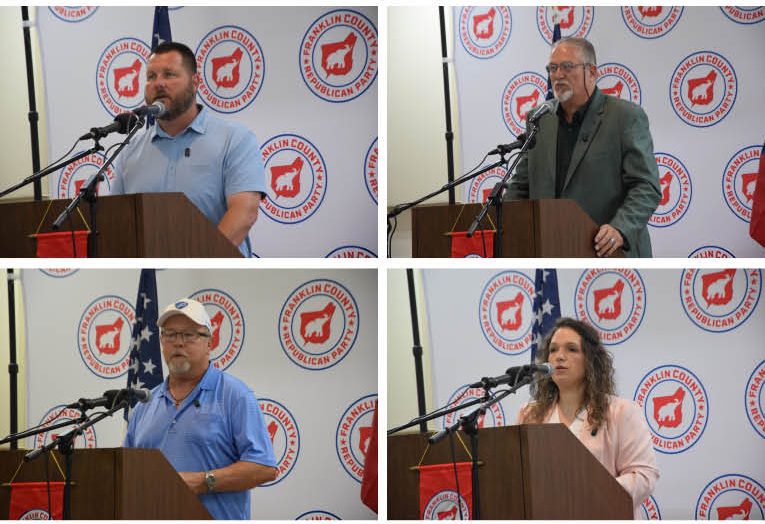
Wesley Fricks and Kyle Westbrook participated in a candidates’ forum sponsored by the Franklin County Republican Party at the Carnesville Community Center.
The candidates introduced themselves in opening statements, answered 10 questions prepared by the Republican Party, and then had closing statements as well.
Westbrook described himself as “a husband, a father, a business professional, a farmer and a lifelong Franklin County guy.”
Westbrook said he has learned the value of hard work, teamwork and showing up for the next generation.
He said he is running for commissioner because he loves Franklin County but is “deeply” concerned for its future.
“Franklin County has always been a special place of strong families, hardworking farmers, thriving small business and classic Southern spirit,” he said. “But we face real challenges. Securing our water supply, managing thoughtful growth without losing our rural character, updating our development codes to be practical and farmer-friendly and making sure agriculture remains a part of our economy. I believe we can plan for the future while protecting what makes Franklin County home. That means reliable water for our families and farms, balanced growth that welcomes a responsible industry without paving over our fields and common sense policies that put taxpayers and local control first.”
Westbrook said he will fight to keep taxes low, to support county employees and volunteers, improve infrastructure and make sure children can grow up and build lives in Franklin County.
Fricks said he is running because he believes the county “deserves strong, common-sense leadership and a future we can all be proud of.”
He said his campaign is built on unifying Franklin County, lowering taxes and being responsible with taxpayer money, encouraging common-sense economic growth that brings opportunity and jobs while protecting the character of the county’s communities and supporting local education.
Fricks said that Westbrook is campaigning to keep the county the same as when he was a child.
“That was a long time ago, people, and that is why we’re in the situation that we’re in,” Fricks said. “We have approximately 25,000 citizens in this county. We have 11,254 households, and 23 percent of those people are renters. And 19 percent are living below the poverty level. Franklin County deserves better than that, and they deserve better than what we’ve had in the last 20 years, and I think there’s nobody in this room that would disagree with that.”
Fricks said he would listen and respect voters and work for them.
“We must come together with unity, common sense, and a shared vision for the future,” he said.
Several of the questions posed to the candidates were about growth.
On smart growth, Westbrook said smart and common sense growth must be practical and balanced.
The county needs to plan ahead, starting with securing a water supply.
“To have growth, we have to have good water, good water supply and clean water,” he said. “We have to protect our land as a priority. And we have to plan ahead using our comprehensive plan, using our [Unified Development Code], and the path that we have set forward for this county.”
The county should avoid land use conflicts like putting a loud industry next to a residential neighborhood or putting houses next to a poultry or hog farm.
“We don’t want threats to our way of life and our health and our affordability,” he said.
Fricks defined smart growth as “identifying opportunities to bring common sense industrial growth to our area.”
“We have four interchanges off of I-85 where we can plant some smart industrial growth in those areas,” he said. “If it does require vehicles, they’re going to be able to get on and off the exits and not drive through communities.”
Fricks said that the county has plenty of property for industrial growth while still protecting farmland.
Asked about how residential and industrial growth affects property taxes, Westbrook said that residences cost the county money because of the cost of services used by the people who live in them versus how much taxes the homes generate.
“We need houses,” he said. “Everybody needs houses. We do. But when we look at a large residential development, we don’t need to get it just because we think we need it. We need to have a purpose for that. We need to have jobs available and things like that. We don’t need to just pursue large residential growth without a purpose.”
Westbrook said the county also needs industrial growth.
“We have plenty of industrial parks available,” he said. “We have land set aside, zones, a lot of industrial and whatnot for this industry, we just got to get it in here. And once we do, we can pick the type of industry we want for this county that’s going to benefit us. We don’t have to rush and take anything that comes.”
Fricks said that question was easy.
“Smart, common-sense industrial growth coming to Franklin County is going to lower your taxes,” he said. “Residential growth is going to increase your taxes.”
Fricks said that he is opposed to residential growth.
On the role of the Industrial Building Authority in development and the IBA’s relationship with the board of commissioners, Westbrook said the two boards need to have a great relationship.
“It needs to be improved,” he said. “We need better communication there.”
Westbrook said the county can work within the structure of the IBA to find industry for the county.
Fricks said he worked with the IBA on projects when he was the executive director of the Ty Cobb Museum.
“We need to put together a cooperative effort with the IBA and the local leadership of the municipalities to come up with an ultimate plan to solve some of our industrial growth problems or water problems,” he said. The IBA is a tool that the county can use to bring in “common-sense, smart, industrial growth” that will help lower taxes, he said.
Asked what factors would influence accepting or rejecting a proposed industrial or residential project, Fricks said that the project would have to be “good fit” for Franklin County.
“It has to be a really good fit for our community, and if it doesn’t benefit every citizen in the county, then I would reject it,” he said.
Fricks said that he would listen to constituents to determine what they want.
Westbrook said his support or opposition would depend on if the project is “good for us.”
“We say no to a lot of things in life so that we can get the good things,” he said. “I just don’t want us rushing to approve everything. We don’t need to feel that way. We need to feel that we can pick and choose what we want in this county because of our location. But definitely anything we get is going to be beneficial to the county if I’m in office, and it’s going to help our taxes, and it’s not going to be a burden to the neighbors and cause unnecessary problems for this county.”
Westbrook said he likes the idea of many smaller industries versus one large industry.
Asked about the tradeoff between recruiting a large industry versus small business and agricultural opportunities, Fricks said the county needs to nurture small and agricultural businesses.
But, he said the county needs the kind of growth that will help lower taxes.
“Everywhere I go and everybody I talk to, I mean it’s a tear fest that the taxes have doubled and the taxes have went up to a point where they’re beginning to wonder how much higher they can go,” he said. “And we’re going to have to have somebody that’s going to be in office that’s going to be aggressive for reducing the taxes and lowering the taxes for our taxpaying citizens. We’re going to have to look at the right industry that’s going to help us do that. And that’s going to be a guiding factor as far as I’m concerned.”
Westbrook said he is not for giving new businesses tax refunds or tax deferrals to bring them into the county.
“I would rather see us offer those types of things to our local guys that want to expand their business and smaller businesses that want to come here,” he said.
Recruiting an industry will have a 100-year impact on the community, he said.
“So you definitely have to be sure that you know the costs, you know the demographics that’s going to come in, the population growth, the burden on your schools, your roads, your infrastructure,” Westbrook said. “So we definitely need to study these industries that come in here to know if we’re going to make money on them or if in the long term it’s going to be a burden that costs us money. That’s something we have to look at and understand the costs in the future.”
The candidates were also asked about infrastructure improvements – specifically water – needed to bring growth.
Fricks said the county needs to work with its cities to fix the water supply issue.
Lavonia has a strong plan to improve its water system, which could help the county, he said.
“I’m learning more and more about that project, but I’m telling you, help is on the way. And as a county commissioner, I’m going to work and do everything in my possible power to bring the county together so that the commissioners can work very closely with the municipal leaders so we can develop a comprehensive plan such as this one and implement it so that it benefits everybody in the county and solves our water problem,” he said.
Westbrook said Lavonia’s plan can help a lot of the county’s problems.
The county’s current work to expand the number of wells is a temporary solution, he said.
The county should also look at longer term solutions like accessing water from Lake Hartwell, from rivers or building a reservoir, Westbrook said.
If Franklin County looks at building a water treatment plant, it should be put close to Lavonia where most of the growth in the county is coming, he said.
The candidates were also asked if they were for removing or amending the UDC and what their definitions were of a “thriving Franklin County.
On the UDC, Fricks said that he has attended the meetings being held by county commissioners on revisions to the planning law.
“I think it needs to be looked at. I think it needs to be determined what we need to do with it,” he said. “There are some complaints out there about what we should do with it. I trust my elected officials that they’re going to make the right call. I’m going to be standing there in those meetings right beside them, helping them and giving input when I can. I hope that they’re looking to all the citizens of Franklin County to get input. Whatever they do, it will impact in a positive way all the citizens of Franklin County.”
Westbrook said he likes the UDC as a whole, calling it a “good working document,” but saying the county needs to continue to work on it.
Westbrook said removing the UDC would be a “nightmare” because it would open the county up to development.
As a comparison, he said that Hart County doesn’t have zoning.
“They’re doing moratoriums trying to stop housing developments, he said. “I don’t know if they have one right now but in the past year, that’s what they are doing because they’re getting houses popping up everywhere on the road.”
There are simple changes – like measuring setbacks from the center of the road – that would help the UDC, he said.
“I think we need to keep working on the UDC,” Westbrook said. “We’re on the right path. And it’s a document that needs to be continued to look at until we find something that satisfies everybody.”
On his vision of a thriving Franklin County, Westbrook said it involves good schools, good jobs and fair taxes.
Getting good industry will help lower taxes, he said.
“If we can try to keep taxes low, then we can make this community thrive,” Westbrook said. “I mean, we have a great county here, we have great people here, and I want to see our people be successful. I want to see our people be able to work here and all, and also be able to have a nice small farm, nice hobby farm or live in a town, in a nice, you know, friendly town with a good downtown area, low crime. That’s what I see in the thriving community.”
Fricks said he will be the hardest-working commissioner the county has ever had.
“I am going to lower your taxes by any and every way that I possibly can,” he said. “I’m going to work, that’s going to be my mission from day one, is to make sure I work hard to lower taxes for the hard-working citizens of Franklin County. You got my promise on it.”
Busby, Payne outline platrom at Franklin County GOP forum
By Shane Scoggins
Publisher
CARNESVILLE – The two candidates for the District 3 seat on the Franklin County Board of Commissioners spoke and answered questions Saturday at a candidates’ forum sponsored by the Franklin County Republican Party at the Carnesville Community Center.
Incumbent Elizabeth Busby and challenger Mike Payne made opening and closing statements and answered 10 questions prepared by the Republican Party.
Busby said it has been an honor to serve as a commissioner.
“Franklin County is a special place,” she said. “It’s worth protecting and planning carefully for the future.”
She said that for three years, she has gained experience that can only be obtained by doing the job.
“I’m proud of what we’ve accomplished so far, she said.
Those accomplishments include a fire training center, settling a lawsuit that kept a piece of property available for future economic growth, updating the county’s Unified Development Code (UDC) and improvements to the jail, elections office, 911 center and health department.
The county is currently working to revise the UDC, find more water supply and with the IBA to recruit prospective businesses to grow the tax base.
Commissioners also voted to opt in to the provisions of House Bill 581, which will help limit the growth of property tax bills, she said.
“If re-elected, I will continue the work we started,” Busby said. “I’ve always tried to be transparent, accessible, steady in my leadership. Franklin County is built on the strength of its employees, administrators and constitutional officers, and I will continue working to ensure that they have the support they need.”
Payne showed a map generated by Georgia Power that shows Franklin County ranks 148th out of 159 counties in economic development.
Surrounding counties are ranked much higher, he said.
“There’s no reason for Franklin County to be 148th on this list,” he said. “There’s no reason for it, and it didn’t start four years ago... it’s just been that way for a long time. Nothing’s been done in this county, and now it’s time for it to start being done.”
Commissioners need to work with the county’s mayors, he said.
Working with the cities will allow the county to address issues such as water supply, wastewater treatment and others, Payne said.
“We have a need for water in the county, and right now, because our commissioners are not working with the city of Lavonia to get their grants for their water treatment plant, we don’t have a contract with the city of Lavonia. [Mayor] Courtney Umbehant told me right up front that he will not give Franklin County a contract for water. He said he will sell us what he’s got left over.”
If the city grows and needs that extra water, the county will be lacking again, he said.
Franklin Springs is working on building a new wastewater treatment plant. The county signed an agreement to send sewage to the plant, but some commissioners want to back out of that, Payne said.
Royston offers natural gas, which the county needs. Commissioners should have helped Royston get water to the Dill’s Food City grocery store location so the store could build back after a fire, he said.
The sheriff’s office trains new deputies at a high cost, but the county doesn’t give the sheriff a budget that will allow him to provide raises to keep the deputies from going to another county, Payne said.
“We’ve got to figure out how to get more tax revenue into this county to be able to fund stuff like [Sheriff] Scott [Andrews’] budget and the other budgets,” he said. “Everybody’s budget’s going to go up this year because everybody’s buying gas just like me and you are. We know it costs more to live right now, and every budget in the county’s going up, so if we don’t get something in here to help with these budgets going up, the taxpayers are on the hook for it.”
Franklin County has five individual cities instead of one big city, he said.
“It’s hard for us to get stuff in here, so we’ve got to work together as a whole,” Payne said.
The candidates were asked about their definitions of smart growth.
Busby said it starts with what the people of the county value the most.
“They value our small-town feel. They value our pastureland. They value the safety of our community. They value that we know each other, and we can trust each other, and lean on each other. And so we need to make sure that we’re protecting that,” she said.
But the county also needs to make sure the community can grow, Busby said.
“We have valuable pieces of land in our I-85 corridors where we could see some really good growth go, and our industrial parks. And some businesses are suitable for [Highways] 17, 59 and 29. We need to look at those individually.”
She said she would like to see industries that are environmentally-friendly, good neighbors who will give back to the community and with a good reputation.
“And I’d also like to see our small businesses grow some of the businesses that we already have here,” Busby said. “It’s just about putting good policies in place and supporting the people that want to come here and grow it where we need to grow it and protect it where we need to protect it.”
Payne said smart growth is getting the best “bang for the buck” with the least impact on the county.
“We do need to preserve the farmland,” he said. “We have industrial parks for the growth. We have the interstate corridor for the growth. I think when you affect somebody’s quality of life, that’s the worst part about it. So we need to keep the growth in the industry where it’s designed to be in the industrial parks and along the interstate corridor.”
Asked about the UDC, Payne said it is a good thing.
“If not, we don’t have any way to stop what we don’t want to come in here,” he said. “It’s a good thing, but it does need to be simplified.”
The UDC is too confusing and should be cut from 400 pages to 10 pages, he said.
“The UDC needs to have the center line on the road, one setback for houses, one setback for agriculture and one setback for industrial in the whole county,” he said. “That way the people in planning and zoning don’t get mixed up when they tell somebody what the setback is on the road.”
Busby said that commissioners need “to roll up our sleeves and do the hard work and make this thing work for us.”
The county should remove restrictions that harm citizens and implement policies that help the county grow while protecting it, she said.
“I think we’re making progress on the UDC, and I think it’s done a wonderful job protecting us from things we don’t want to see approved,” Busby said. She added she is for keeping it but continue to work on it.
Asked about the effect of residential and industrial growth on property taxes, Busby said studies show that residential growth costs more than it brings in revenue.
Industrial growth brings in more revenue that it costs, but farmland has the biggest surplus of revenue to cost.
“We need some commercial and industrial growth to offset the residential increases that we’re getting,” she said.
Farmland is valuable, she said, so it needs to be protected.
“If we bring in some industrial growth that doesn’t have a huge financial burden on us and on our resources, and that we can support the workforce for, then that would definitely increase the quality of life here and the money that we are spending on our tax bill,” Busby said. “But if we bring in industry that uses up all of our water, that’s a serious concern. If we bring in an industry and we need 3,000 people to come in here to work at it, we’re probably not going to see a lot of good return on that.”
The county needs to take its time and make good decisions, she said.
Payne said that residential growth costs the county money, but it is going to happen.
The county has grown 23 percent since 2000 and is expected to grow 27 percent more by 2050.
Those homes bring in students to the school system that cost a lot to educate, he said.
“It’s our job to raise the money, to bring the industry in, the retail stores in, to make that money, to keep the taxpayers from having to foot that bill,” Payne said. “If we don’t bring some industry and retail stores into this county, our property taxes are going to be so bad that people can’t pay them.”
On developing infrastructure to help spur development, Payne said that water issues are a growing problem in many counties.
The agreement to buy water from Lavonia has fallen through the cracks, and if the city grows, the county will get less water, he said.
“We’ve got too many rivers, creeks, lakes in the county,” Payne said. “Maybe we need to build a watershed lake somewhere and put a water treatment plant on it. Maybe we need to put it on a river. But it’s got to be decided because 25 years from now, we’re not going to be able to drill enough wells to keep this county on water.”
Busby said water is a hurdle for the county right now.
Dry weather last summer and a reduction in the amount of water the City of Toccoa sold the county, put the county’s system in danger of losing water pressure and fire suppression.
The county also lost water from a well in Madison County that was hit by lightning.
Franklin County has done a geological study that will pinpoint locations for new wells and has upgraded its Highway 59 pump station to allow more water from Lavonia.
Lavonia expects its upgrade project to have enough water to meet the county’s needs, she said.
The county has also started the process to get access to water from Lake Hartwell, which would be a long, expensive process.
“We need to plan 20 and 30 years down the line,” Busby said.
She said that wherever the county puts water and sewer lines, there will be growth.
“We just need to be very intentional about that,” she said.
On the commissioners’ relationship with the IBA, Busby said that both boards have their roles in bringing in industry.
The IBA is responsible for securing the industry and marketing the community, she said, while the board of commissioners provide infrastructure and zoning policies and decide if the development is a god fit.
“We, as a board, need to let the IBA know what we want,” Busby said. “We need to trust them to go out and recruit that kind of business. And they need to be able to trust us that once they recruit that business, we will support it.”
She said she has been in constant contact with IBA President and CEO Tonya Powers during her term.
Payne said the IBA gets a lot of money from the county and needs to work with the IBA to get the right industries into the county.
Right now, some commissioners have problems with the mayors who make up the IBA, he said.
Asked what factors would cause a vote for or against a potential industrial or residential project, Payne said he would approve developments that bring less impact on the county, more jobs and more tax revenue.
Potential developments would have to be a good fit, he said.
“You can’t go out there and put a chicken rendering plant right in the middle of Carnsville right here,” he said. “It’s not going to work.”
Busby said she would look at location.
“If it’s harmful to our citizens, their reputation, what kind of infrastructure needs they have, are they going to be able to manage their resources, are we going to be able to meet those needs? Are they willing to help build up the infrastructure that they need? Are they environmentally friendly?” she said.
On the tradeoff between large industrial projects and small businesses or agricultural jobs, Busby said that they can co-exist.
“I would love to see more small businesses here flourish,” she said. “I would love to see some smaller-scale industrial projects brought in that don’t have the huge water needs or huge sewage needs or a large workforce that we can’t support.”
Payne said the county needs both.
“We need the industry in the industrial parks,” he said. “We need the retail stores on the interstate corridor. We get people driving up and down the interstate bringing sales tax into this county to stop and spend money. They leave, we make sales tax money. We need the mom-and-pop cabin shop right next door. We need the mom-and-pop body shop. We need both. We need it all. We need the jobs. We need the tax revenue. We need everything from it.”
The county is behind and if it doesn’t start working to catch up, it never will, Payne said.
On how to evaluate the long-term fiscal impact of industries, Payne said putting industries in industrial parks is a key.
Locating in those parks keeps trucks off county roads and onto state roads, he said.
“We’ve got places for this stuff,” Payne said. “There’s no reason to have it spread out and cause a big expense for the county. We need to put it in the right place when it comes in here and make no exceptions for it.”
Busby said that if there is a concern about the cost of an industry, the county can ask for a fiscal impact study.
The county also should be careful giving tax abatements to lure industries, she said.
“It goes back to our infrastructure. Putting those where we already have the infrastructure, making sure we’re recruiting businesses that we have the infrastructure to support. And we just need to think long-term. We can’t be short-sighted. We’ve got to think long-term. We’ve got to think down the road,” she said.
The final question was about the candidates’ vision for a thriving Franklin County.
“We just need to protect our rural way of life,” Busby said. “We need to promote growth where it goes. A thriving Franklin County has cities that are thriving and flourishing, and our rural way of life is still protected.”
“My vision of a thriving Franklin County is a happy Franklin County,” Payne said, “not people fussing every time you talk to somebody about the taxes being too high.”
Franklin County has an opportunity to be a great county.
The county needs good paying jobs and retail stores like Target so people can shop here instead of going to Anderson or Hartwell.
“We need to build this county up the best we can and make this a thriving county within the state,” Payne said.
In closing, Payne emphasized that the county needs to work with the cities and have a good relationship with them.
A renegotiation on the local option sales tax is coming up with the cities, he said, and if the negotiation doesn’t go well, the county could go from getting 74 percent of the revenue to 45 percent.
That negotiation will rely on the relationship with the cities, he said.
“I ask that everybody in here do your homework before you go to the polls,” he said. “See who the best person for the job is.”
Busby said that during the campaign and at the forum, voters have heard plans, policies and priorities.
“All of these things are important,” she said. “But at the end of the day, this job really comes down to something similar. Showing up, listening, and making decisions that are in the best interest of the people that we serve.”
She said for the past three years, she has had that as her mindset, “to answer questions and to be someone that you can come to. I’ve tried to be thoughtful in decision making, understanding that the choices we make today will impact this county for years to come.
“We may not always agree on every issue, but if given the opportunity to continue serving, I will keep doing what I’ve done: working hard, listening carefully and doing my best to represent you with integrity and confidence. I care deeply about this county and the people in it, and I’m committed to continuing the work that we’ve started.”
E-SPLOST extension would fund facility, athletic upgrades
By Charlie Eavenson
Staff Writer
In addition to the races for state and local offices on the May 19 ballot, there will be a local referendum to continue a one cent special purpose local option sales tax for educational purposes, commonly referred to as E-SPLOST.
The one percent tax is nothing new for the Franklin County School System.
For the past 29 years, Franklin County Schools has used funds from the tax to maintain, renovate and upgrade existing facilities, build new facilities and buy equipment and new buses.
Money from the current E-SPLOST VI was used to build the new South Franklin Elementary School. The entire $28 million cost was raised through E-SPLOST funds.
The current E-SPLOST will expire in late summer or fall of 2027, once the cap of $30 million has been collected.
If the referendum to extend the tax passes on May 19, collections for E-SPLOST VII will begin immediately after the cap is met on E-SPLOST VI.
The new E-SPLOST VII is expected to raise up to $52 million between 2027 and 2032.
The measure on the ballot will provide for the possibility of issuing bonds for up to $24 million of the $52 million.
Assistant Superintendent Carl Dekker indicated that the bond issue would probably be done in 2028, after a period of time to determine how the revenues are coming in.
He estimates the interest on the bonds will be about 2.8 percent.
“The benefit of issuing bonds is that it allows the school system to begin construction on major projects sooner,” Dekker said, “instead of waiting for all the funds to accumulate. This can usually result in significant savings due to the higher rate of inflation.”
Franklin County School Superintendent Melanie Burton-Brown said the school board and administration have worked since last spring to develop a 10-year vision for the school system.
“Planned projects include renovations at Lavonia Elementary; a new roof and renovations at Carnesville Elementary; HVAC and restroom improvements at the Middle School; HVAC upgrades and renovations to the [English/language arts] wing and Telford Auditorium at FCHS,” Burton-Brown said in a prepared statement. “Proposed construction projects include a new competition gym and agriculture facility.”
A more detailed report shows additional projects including student Chromebook replacement; middle school athletic field lighting; E-rate technology equipment; a new athletic field for the FCHS band, flag football team and possibly soccer team; expansion of high school parking; and annual bus purchases.
Construction of a new high school gym is expected to begin in 2029 and be completed within 18 months.
The new gym will be built with consideration for basketball, competition cheer, volleyball and wrestling.
Dekker explained that it is impossible to renovate the existing Lions’ Den gym until the new gym is completed.
Therefore, that renovation project will probably be beyond 2032, the end of SPLOST VII.
A budget summary of the proposed projects shows the following:
• New construction – $24,000,000;
• Building renovations – $16,450,000;
• Transportation/buses – $5,000,000;
• Athletics – $3,000,000;
• Technology – $2,300,000;
• Facility systems/HVAC – $1,000,000; and
• Safety – $250,000.
“Franklin County Schools appreciates the trust the community has placed in us over the past 29 years through E-SPLOST,” Burton-Brown said in her statement. “This program has played a critical role in the development of our facilities, impacting every structure on every campus and benefiting the community in countless ways.”
Dekker has been attending civic organization meetings to remind citizens to support the continuation of the E-SPLOST by voting “yes” on the “special election” question.
Material provided by the school system indicates that E-SPLOST funds have allowed the system to “maintain a downward trend in the millage rate, reducing the property tax burden.”
Since 2020, the FCSS millage rate has been lowered almost 18 percent, from 17.0 mills to 14.0 mills.
Dekker has said in presentations to the board of education that studies have shown a significant portion of SPLOST funds come from people visiting or passing through the taxing county. This is especially true since Franklin County has four exits on I-85.