
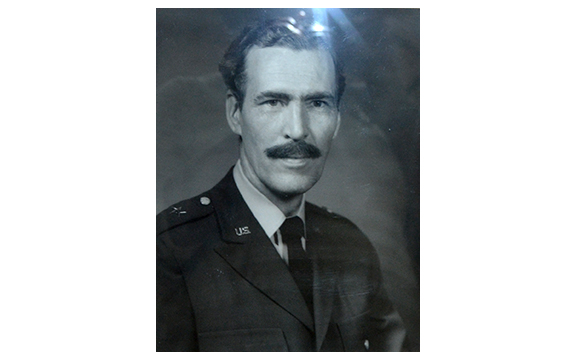
Editor’s note: The following is a story written by Gen. Eugene Phillips of Royston on the eve of battle in World War II. It has been called “one of the best pre-battle accounts” written. It was submitted by Paul Crawford.
By Lt. Eugene Phillips
All my life I’ve wondered what thoughts a man might have just before going into battle.
In the morning, two hours before the dawn, I shall know.
There is something hazy and hurried and indistinct about “great moments,” an unreal quality that renders details somehow indistinguishable later.
Such a “moment” you experience as you stand there at the rail of the transport with a lump in your throat and watch your native land fade into the mist.
This is no pleasure cruise! You are off on a great offensive. This is the Second Front!
It might be a “one-way” trip.
A lot depends on Fate.
There is a certain sameness about the helmeted faces that crowd the rail for a last fleeting glimpse of home. They are soldiers and their uniform seems to make them all alike.
These are American soldiers and theirs is a mighty mission.
The Commanding General has said so. “The eyes of the world are watching us; the heart of America beats for us; God is with us. On our victory depends the freedom or slavery of the human race. We shall surely win!”
His words were inspiring.
“When the great day of battle comes, remember your training; remember above all that speed and vigor of attack are the sure roads to success, and you must succeed – for to retreat is as cowardly as it is fatal. Indeed, once landed, retreat is impossible. Americans do not surrender!”
Men in this same uniform wrote that line into history at Bataan and on Corregidor; in New Guinea and the Solomons; and at Guadalcanal.
Americans do not quit.
‘’During the first few days and nights after you get ashore, you must work unceasingly, regardless of sleep, regardless of food. A pint of sweat will save a gallon of blood!”
The general has spoken.
You know by the grim line of their chins that his troops have heard.
Slowly the mainland fades and the gentle roll of the ship tells you that you’re on the open sea. By noon only an indistinct line on the horizon remains of the land you have known and loved as home.
Byron comes to mind.
“Adieu, adieu, my native shore fades o’er the waters blue!”
Yet there is a difference. Byron despaired of ever seeing his homeland again.
Not these confident, helmeted men in olive drab! They will win the victory in battle, for there are no better fighting men in the world. And they will win the peace.
They are all coming back. They all think so.
A soldier never considers that he might be killed. Always, he thinks, it will be a comrade by his side who will fall.
They are coming back, all of them.
You can detect that belief in their letters, which you must censor.
“I’ll be back in six months, honey!” is the optimistic promise they make to the girl back home.
You know it when you overhear their bantering.
“I have a date with a girl in San Francisco for Christmas, 1944!”
A man must hope, even though he knows in his heart that his chances of getting back home are less in this war than when his dad went across 25 years ago.
Our casualties will be greater. But then, our stakes are greater, too.
These men whose faces are shadowy and indistinct beneath their helmets know that. When you look at them you sense their determination that this time they’ll do the job so well it won’t be necessary for their sons to make this excursion of war a generation hence.
They will win the peace.
There is no flag waving, no hysteria here. These men are serious. Deadly serious.
Strong silent men, they sit and sharpen bayonets, whet trench knife blades to a razor-like edge.
Fondly, almost reverently, they clean and oil their weapons, better weapons – and more of them – than their dads had in 1917. They’ve had more training, too.
The sea is calm and you hardly discern her progress unless you gaze out at the other ships on either side and behind.
“Darken ship!”
The command rings out just as the sun is sinking behind you. By dark not a light is visible. The ship’s whistle has an eery sound in the misty night. Gun crews and lookouts alert, the powerful ship plows steadily ahead, leading the mighty convoy.
Sunlight streams into your cramped quarters from opened portholes and you realize that another day at sea has dawned. The tangy salt air gives a hearty appetite for a breakfast of ham and eggs. Food like this is not to be had in the field.
A soldier looks about on deck and sees only water visible for miles around.
“I don’t think we moved all night!” he shouts.
“This reminds me of Kansas!” pipes another.
The ocean is a majestic thing.
As far as eye can reach her expanse is unbroken, except for the transports and supporting vessels of the convoy.
‘Tis a magnificent and impressive scene. Your chest swells with pride.
“The largest combat-loaded convoy ever to sail from any port in any war in the world’s history!” A powerful force with a glorious mission!
At best, ship life is monotonous, but on this trip there is much to be done. There are no idle moments.
Twenty-four hours out orders are opened and troops are told their destination and mission, and how they will accomplish it. “D-Day” is announced and a thrill races through your veins!
Endless command conferences; lectures to troops on the language, literature, religion, and customs of the enemy; instruction in weapons and tactics; codes and communications; countless minute details and plans are elaborated before an eager audience.
Early and late, commanders pore over maps and charts, studying battle order, discussing plan. No item is overlooked to insure victory.
Rapidly, but carefully, plans for the great offensive were drawn. Quickly and smoothly they must be executed. There are alternate plans should events necessitate a change.
Troops exercise on deck, read, relax in the sun. Boxing and wrestling come in the afternoon. Movies are shown at night. Food is plentiful. Morale is high.
Now and then they must do their laundry. Fresh water is scarce, but a salt water shower proves invigorating. (Don’t use ordinary soap!)
All guns on deck are limbered up occasionally in practice firing. Easy fingers caress triggers and automatic weapons fire a symphony of destruction. These soldiers know their arms, and they are confident in their use. Even in the darkness they can repair them.
One morning a number of anti-aircraft machine guns opened up topside.
‘’Sounds just like the German machine guns 25 years ago,” spoke an old Colonel, veteran of World War I.
“Listen to that music!” chirped a private, “I only hope I hear him on the flank when we rush that bridge!”
Deck scenes are vivid. These men in khaki make them stirring ones.
You hear the ship’s gun crew, eagerly keeping the muzzle trained (just for practice) on a friendly naval observation plane, lustily singing “I Want a Girl, Just Like the Girl That Married Dear Old Dad.”
High above sounds the strong, clear tenor of the lookout, scanning the skies with his glasses, in the mellow strains of “When Irish Eyes Are Smiling.”
Below on deck an ashen-faced soldier enjoying the trip none too well complains of a “floating stomach.”
Somewhere on the ship you can hear a mouth organ pealing forth the stirring “Marine Corps Hymn.” From a cabin on “A” Deck comes the wailing notes of a “sweet potato,” rendering “Deep in the Heart of Texas.”
Late one shrouded night on the upper deck, a young Lieutenant, his tall figure a faint silhouette against the rail, whistled softly the haunting strains of “Amapolo” as he gazed across the lapping waves toward home.
The things men think about as they go off to war ….
Strangely, soldiers never think of themselves as they are about to go into battle. Nor are they afraid of death. They only fear that they will be afraid. At the last, when men go “over the top,” they are not afraid.
About to enter combat, soldiers make light of it, laugh, banter, and wisecrack.
“We’ll soon have some good dirt under or over us!” joked a Sergeant to his men, weary of the sea.
The sixth day out a “sub scare” disturbed the routine as an unidentified submarine was “contacted.” Accompanying destroyers dropped “ash cans” as depth charges are termed by the Navy and tell-tale oil splotches appeared on the surface. We heard they got several, but rumors travel fast aboard ship.
“If a torpedo hits us I won’t have to worry about it,” laughed a Corporal seated on a case of high explosive grenades, calmly enjoying a card game.
American soldiers are like that.
It is the reckless quality our elders so often deplore in youth.
They are reckless, but they are serious. You sense it as “D-Day” nears and your ship draws ever closer to the shore that must be taken at all costs.
They are attentive as you give your final orders, carefully reviewing the part each man will play.
Tomorrow is “D-Day!”
You sense your deep responsibility. You are to lead these men into battle! “Can I do it?” you ask.
A man will do what he must.
At this last moment a man ceases to be human. He becomes a machine with certain mechanical functions. He is a small cog in the vast machine of war.
“A pint of sweat will save a gallon of blood.”
H-Hour comes in the morning!
The Chaplain chants a final mass and reads a last passage (Psalms 140:7; 144: 1-2): “O God, the Lord, the strength of my salvation, thou has covered my head in the day of battle .... Blessed be the Lord my strength which teacheth my hands to war, and my fingers to fight; My Goodness and my fortress, my high tower and my deliverer, my shield and he in whom I trust.”
“When the great day of battle comes, remember that speed and vigor of attack are the sure roads to success!”
You recall the General’s words.
“Americans do not surrender!”
His message somehow inspires you. “The eyes of the world are watching us; the heart of America beats for us; God is with us. On our victory depends the freedom or slavery of the human race. We shall surely win!”
Before another sun has set America will know!